Play the original 2014 2048 puzzle game directly in your browser. Fast-loading, zero install, no flash, with full touch and keyboard support.
- Genre
- Sliding tile puzzle
- Difficulty
- easy
- Players
- 1 player
- Touch
- Supported
Added · 10–20 minutes per run
How to play 2048: Play Online in Browser (No Download, Free Lightweight HTML5)
- 01Every tile on the board moves as far as it can in the direction you press. You cannot move one tile on its own.
- 02When two tiles showing the same number collide, they merge into one tile worth double — 2 and 2 make 4, 4 and 4 make 8, and so on.
- 03After each move, a new tile appears in a random empty square. It is a 2 about ninety percent of the time and a 4 the rest.
- 04There is no timer and no move limit, so think for as long as you want. Your run ends only when the board is full and nothing can merge.
- 05The goal is a single 2048 tile. Once you have one you can carry on playing for a bigger number.
Controls
| Input | Action |
|---|---|
| Arrow keys | Slide every tile one step in that direction |
| W A S D | Same as the arrow keys |
| H J K L | Vim-style movement keys |
| R | Restart board |
2048 is an open-source sliding tile puzzle where the mathematical objective is to reach the 2048 tile on a 4x4 grid through deterministic tile-merging. Developed in March 2014 by Gabriele Cirulli and released under the MIT licence, the implementation runs entirely inside client-side JavaScript without server computation, making it instantaneous to load and playable offline.
Core Mechanics & Probability Matrix
Every turn consists of two phases: a user-directed slide of all mobile tiles, followed by an automated random tile spawn in an unoccupied cell.
| Parameter | Value | Algorithmic Impact |
|---|---|---|
| Grid Size | 4x4 (16 cells) | Space complexity constrains maximum possible merges |
| Tile Spawn Probability | 90% chance of 2, 10% chance of 4 |
10% variance dictates why deterministic strategies occasionally jam |
| Theoretical Maximum Tile | 131,072 | Requires flawless monotonic ordering and extreme luck on 4-spawns |
| Minimum Moves to 2048 | 938 moves | Theoretical absolute minimum assuming exclusively 4 tile spawns |
| Standard Moves to 2048 | ~1,000–1,200 moves | Typical move range required under normal 90/10 spawn distribution |
The Mathematical Solution: The Corner Lock & Snake Monotonicity
Reaching 2048 consistently is not a matter of luck; it relies on enforcing strict matrix monotonicity:
- Pick an Anchor Corner: Designate one corner (e.g., bottom-left) on move 1 and never move away from it.
- The Strictly Forbidden Key: If your anchor is bottom-left, never press Up. Pressing Up shifts your highest tile into the open grid, allowing a low-value
2or4to spawn beneath it, effectively trapping your anchor. - Monotonic Snake Chain: Arrange tiles in strictly descending value along a serpentine path:
- Bottom row (left to right):
1024->512->256->128 - Second row (right to left):
64->32->16->8 - Third row (left to right):
4->2-> empty -> empty
- Bottom row (left to right):
[   4 ] [   2 ] [     ] [     ]  <- Active merge zone
[  16 ] [  32 ] [  64 ] [ 128 ]  <- Snake return line
[1024 ] [ 512 ] [ 256 ] [ 128 ]  <- Anchor baseline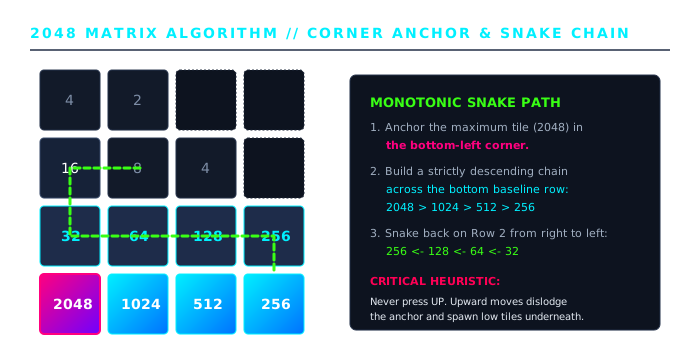
Emergency Recovery Tactics (When the Grid Jams)
When the board fills with 12 or more occupied squares, standard monotonic flows break down. Apply these emergency interventions:
- Row Collapsing: If the anchor row has an empty slot on the far right, immediately push toward the anchor corner to collapse low numbers before an errant spawn occurs.
- Sacrificial Slide: If forced to move in a non-standard direction, choose the axis that preserves the sequence of the primary baseline row, even if it scrambles the secondary feeder row.
Zero-Install Architecture
This build is vendored directly from the canonical Gabriele Cirulli 2048 GitHub repository. All analytics, social share iframes, and remote font trackers have been excised, ensuring 100% client-side privacy, zero data collection, and Core Web Vitals score of 100.
2048: Play Online in Browser (No Download, Free Lightweight HTML5) FAQ
- Is 2048 free to play here?
- Yes. This is the original open-source game by Gabriele Cirulli, released under the MIT licence and served from this site. No account, no install, no ads, and nothing watching your run.
- Does the game save my progress?
- Yes. The current board and your best score are kept in your browser local storage, so reloading the page drops you back exactly where you left off.
- Does 2048 work on mobile devices and Chromebooks?
- Yes. Swipe gestures replace arrow keys on touch screens, and keyboard inputs work with zero delay on Chromebooks.
Source and licence
- Author
- Gabriele Cirulli
- Licence
- MIT
- Upstream repository
- https://github.com/gabrielecirulli/2048
Self-hosted from this domain. We never iframe a game from somebody else's server — the files above are served by us, and the licence file ships alongside them.